Recently, I started a project that came out of a discussion with my childhood friend while planning his wedding.
As we were looking at vendors that print wedding invitation cards, we quickly realized how expensive it could get. During our research, we found that a decent invitation card would cost anywhere between 250 and 450 birr per card. For someone inviting around 700 guests, that becomes a significant expense.
It was during this search that we came across Yeneserg on social media. It was the first time I had heard of a digital invitation service like that.
The idea is actually pretty cool. Instead of printing and distributing hundreds of invitation cards, you simply send a link to your guests. It saves both time and money while also enabling features that are impossible with a traditional paper invitation.
We started discussing whether the idea would work for our specific situation. After going back and forth for a while, we eventually decided it wasn’t the right fit for us at the moment. However, we liked the concept of digital invitations so much that we decided to borrow the idea and integrate it into our own invitation process.
Why We Didn’t Go Fully Digital/YeneSerg
A few factors influenced our decision.
- Guest Segmentation: In our case, we couldn’t rely entirely on digital invitations. Not all guests have smartphones, and some of the older attendees may not be comfortable interacting with a digital invitation. That meant we would still need to maintain two invitation processes: one digital and one physical. Managing both felt like more work than simply using traditional invitations.
- Digital Check In: The digital invitation services promote QR code based check in systems. While this sounds great in theory, we felt it wouldn’t work smoothly for our event. Digital transformation in our country is still ongoing, and introducing QR code scanning at the entrance could easily create long queues and a poor experience for guests. Sometimes, handing over an invitation card and walking in is simply faster. And not a long ago we have seen the impact of such initiatives during fuel payment digitization within the country.
- Design Preferences: We also felt that the invitation page designs we saw were not quite our style. This is entirely subjective, of course, but none of the available templates felt like a good fit for our eyes.
More than anything else, there was a cultural aspect to consider. In our society, sharing important life events carries a certain weight. Sending a simple invitation link through a messaging app for a once in a lifetime event can feel somewhat impersonal or even disrespectful.
As younger and more tech savvy individuals, we understand the convenience. However, weddings are often as much about the families as they are about the bride and groom themselves. Many guests are invited by parents, relatives, and family friends people who place great value on traditions and formalities. For them, receiving a physical invitation card still has meaning. Because of that, completely replacing the physical invitation didn’t feel right.
Finding a Middle Ground
In the end, we decided on a hybrid approach. We would print physical invitation cards while integrating a digital experience through a QR code on the card. This way, guests could still receive a traditional invitation while gaining access to additional features such as:
- The couple’s story
- Wedding details and schedule
- Photo galleries
- Interactive location maps
- RSVP forms
- Guest wishes and messages
- Additional event information
To reduce costs even further, we designed and printed the cards ourselves.
The End Product
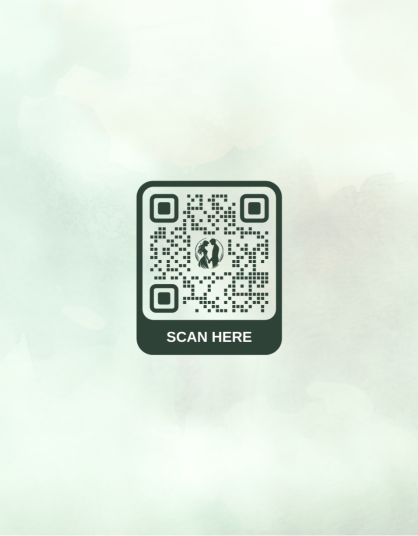
We created a custom invitation design in Canva and added a QR code on the back of each card. The QR code links directly to the digital wedding invitation portal.

Building the Digital Invitation
The first version of the digital invitation was surprisingly built in a single night using Google Stitch and Google AI Studio. I started by describing the design I wanted in Google Stitch, made a few adjustments, and then used AI Studio to generate the initial implementation.
I was genuinely impressed with what could be built in such a short amount of time.
The first prototype already included:
- A beautiful hero section with changing background images
- A story section with detailed popups
- A wedding countdown timer
- Interactive map location
- Photo gallery
- Calendar integration
- Event timeline section
Honestly, it was already good enough for our needs. But once the foundation was there, I couldn’t stop improving it. Over the next day, I added several new features:
- Background wedding music with mute/unmute controls
- Amharic language support
- Improved image and gallery sections
- A countdown that continues after the wedding date as a “time married” counter
- A video section for pre-wedding moments
- Support for both Google Maps and Apple Maps
- A Telegram community section where guests could share memories
- A “Leave a Wish” section
- RSVP functionality so guests could confirm attendance
At that point, I was extremely happy with the result. The entire portal had taken only a couple of days to build and polish, but I started feeling that all this work would be wasted if it was only used for a single wedding.
That thought led to the next phase of the project.
The Refactoring
At some point, a simple thought crossed my mind: “I’m in IT. I love open source. I always talk about the importance of open source. Why not spend a little more time on this and give it back to the community?”
So I started transforming the project from a one time wedding website into a reusable platform that anyone could use. The first step was removing all the hard coded content and moving it into configuration files.
From there, I:
- Made sections configurable and toggleable
- Added support for any language
- Introduced multiple themes
- Simplified customization through configuration files
- Made it easy to host for free using GitHub Pages
Along the way, I integrated several free services:
- Google Sheets for RSVP tracking
- Formspree for guest wish notifications
- Google Analytics for visitor insights
Once everything was working, I published the project on GitHub (TadiosAbebe/wedding-invitation-and-rsvp-portal) and documented it thoroughly.
The documentation covers:
- Features
- Setup and deployment
- Configuration and customization
- Integrations
- Development and contribution guidelines
The Result
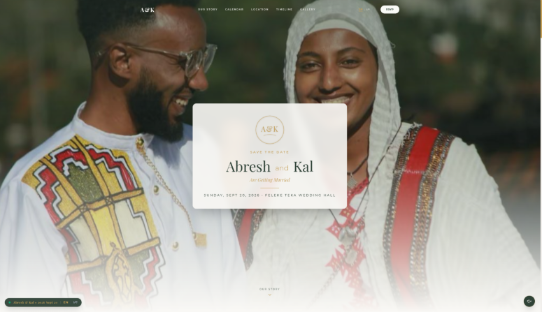
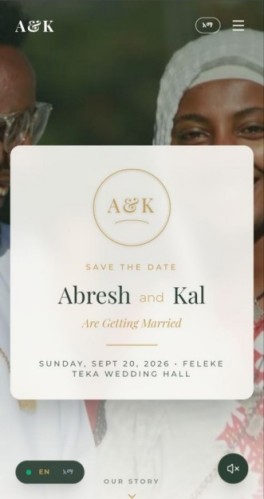
What made me happiest wasn’t the code itself. It was knowing that someone with a little technical experience could:
- Fork the repository
- Modify a few configuration files
- Enable GitHub Pages
- Deploy their own digital wedding invitation
All without paying for hosting or specialized software.
What started as a conversation about expensive wedding invitations ended up becoming an open-source project that anyone can use.
If you’re getting married, have family or friends planning a wedding, or simply want to experiment with digital invitations, I encourage you to give it a try and share your feedback.
I’d love to see how others use it and what improvements can be made along the way.